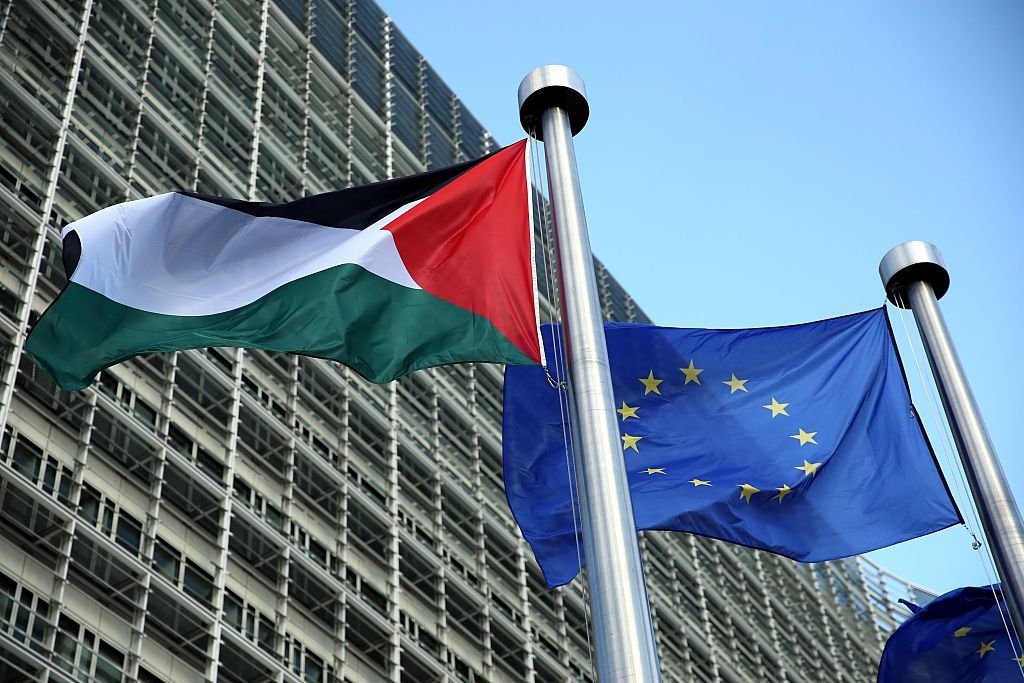
Which countries will recognize Palestine before 2027?
Belgium




Order Book
Belgium
Resolution Criteria
This market will resolve based on the countries that officially recognize Palestine as a state by December 31, 2026, 11:59pm ET. An announcement of intentions will not suffice to resolve this market to "Yes." Only a government's formal recognition of the State of Palestine will count toward a “Yes” resolution for this market. The primary resolution source for this market will be official government information. However, a consensus of credible reporting will also be used.
This market tracks which of ten specific countries will formally recognise Palestine as a state before the end of 2026. Trading is broadly distributed across the ten outcomes rather than concentrated on a single country, with Belgium, the Netherlands, and New Zealand among the heaviest-backed to complete formal recognition by 31 December 2026. Resolution requires official government action, not a statement of intent.
Market structure
Ten separate yes/no outcomes track individual country recognition by 31 December 2026, 11:59pm ET. Volume is broadly distributed, with a small cluster of European nations and New Zealand drawing heavier backing than others. Belgium, the Netherlands, and New Zealand are the heaviest-backed outcomes. The United States, Germany, and Austria carry the lightest backing. Resolution requires a formal government recognition act, not a policy announcement. Primary source is official government records, supplemented by a consensus of credible reporting.
Background
The question of Palestinian statehood recognition gained renewed urgency from 2024 onwards, when a wave of European countries — including Norway, Ireland, and Spain — announced formal recognition of Palestine. This prompted debate across governments that had previously deferred, particularly within the European Union, where member states hold divergent positions. Several parliaments passed non-binding motions or government ministers signalled openness to recognition, but formal legal steps remained incomplete in many cases. The conflict in Gaza, ongoing since October 2023, has kept the issue at the forefront of foreign policy discourse. Countries outside the EU, including New Zealand and Japan, have faced similar domestic and diplomatic pressure. Recognition by a major Western economy such as Germany or the United States would represent a significant shift in the international landscape, which is why even low-probability outcomes in this market attract attention.
Key factors
The pace of European Union-level diplomatic momentum influences member states; a coordinated EU position, if it emerged, could accelerate multiple recognitions simultaneously. Domestic political calendars matter significantly — governments facing elections may defer contentious foreign policy decisions, while newly formed coalitions may introduce recognition as part of coalition agreements. The state of the Gaza conflict and any ceasefire or peace-process developments could shift political calculations rapidly in either direction. Individual countries' treaty obligations, existing bilateral relationships with Israel, and trade dependencies create varying thresholds for action. Parliamentary vs executive recognition routes differ by country: some require legislative votes, others can proceed by cabinet decision alone, affecting the speed and reversibility of any formal step. US recognition is structurally constrained by Congressional dynamics and executive branch posture, making it sensitive to presidential and legislative developments through 2026. Japan's recognition would mark a notable shift in its traditionally cautious diplomatic stance and depends heavily on foreign ministry consensus-building.
FAQ
How is the 'Which countries will recognise Palestine before 2027?' market resolved?
Each country's outcome resolves 'Yes' only upon a formal government recognition of the State of Palestine — a cabinet decision, royal decree, or equivalent legal act. A statement of intent, a parliamentary motion, or a ministerial comment does not qualify. Official government records are the primary source, with credible media consensus as a secondary check.
When does this Palestine recognition market resolve?
Each outcome resolves based on whether formal recognition occurs by 31 December 2026, 11:59pm ET. Any recognition announced before that deadline but not yet enacted in law would not count unless the formal legal act is also completed within the window.
What happens if a country announces it will recognise Palestine but has not completed the formal process by the deadline?
An announcement of intent does not resolve the market to 'Yes.' If the formal legal recognition act — such as a cabinet resolution or equivalent government instrument — is not completed by 31 December 2026, the outcome resolves 'No' regardless of any prior statements or parliamentary votes.
What does the Palestine recognition market currently show?
Trading is broadly spread across all ten countries. Belgium, the Netherlands, and New Zealand are the heaviest-backed outcomes. Italy and Japan sit in a middle tier. The United States, Germany, and Austria carry the lightest backing, reflecting the structural and political barriers to formal recognition in those countries within the timeframe.
Paridesk is not a regulated financial advisor. The information above is for informational purposes only and does not constitute financial, investment, or trading advice. Prediction markets carry risk of total loss. Past patterns do not guarantee future outcomes.
Related Markets





Belgium
14%