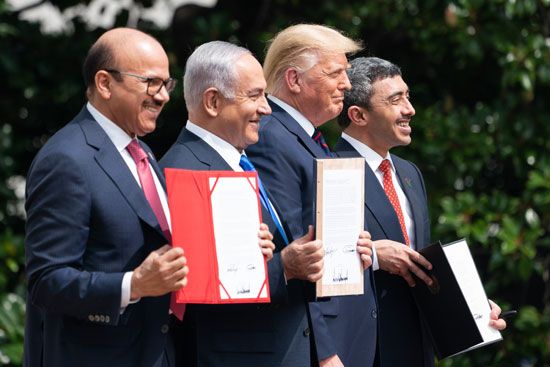
Which country will join Abraham Accords before 2027?
Somaliland
Order Book
Somaliland
Resolution Criteria
This market will resolve to "Yes" if the listed country formally signs a normalization agreement with Israel under the framework of the Abraham Accords by December 31, 2026, 11:59 PM ET. Otherwise, this market will resolve to "No". A formal signing refers to an official agreement between Israel and another country that is publicly acknowledged by both governments and clearly attributed to the Abraham Accords or their continuation. The resolution source will be official government statements, however a consensus for credible reporting may also be used.
Somaliland is the heaviest-backed country to formally join the Abraham Accords before 2027, according to current prediction market trading, though the field remains broadly distributed across seven candidates. Lebanon, Azerbaijan, Syria, Oman, Saudi Arabia, and Kuwait also attract meaningful volume. The market resolves 'Yes' for any listed country that formally signs a normalisation agreement with Israel under the Abraham Accords framework by 31 December 2026, with official government statements as the primary resolution source.
Market structure
The market covers seven distinct country outcomes — Somaliland, Lebanon, Azerbaijan, Syria, Oman, Kuwait, and Saudi Arabia — each resolving independently to 'Yes' or 'No'. Volume is broadly distributed rather than concentrated, with Somaliland the heaviest-backed single outcome and no clear two-horse race. Resolution requires a formal, publicly acknowledged normalisation agreement attributed to the Abraham Accords or their continuation by 31 December 2026, 11:59 PM ET, verified against official government statements or credible reporting consensus.
Background
The Abraham Accords, brokered in 2020, produced normalisation agreements between Israel and the UAE, Bahrain, Sudan, and Morocco, representing the most significant reshaping of Arab-Israeli diplomatic relations in decades. The accords were framed as a template for broader regional normalisation, with the United States playing a central facilitation role. Progress stalled significantly following the outbreak of the Gaza conflict in October 2023, which complicated diplomatic momentum across the region. Nevertheless, various governments have continued to engage in reported back-channel discussions, and the framework itself remains formally active. The inclusion of Somaliland — a self-declared but internationally unrecognised territory — reflects its previously reported security and diplomatic engagement with Israel, adding an unconventional dimension to the candidate field.
Key factors
The trajectory of the Gaza conflict and any ceasefire or post-conflict settlement will materially affect the political environment for Arab-state normalisation. Domestic political pressure in Gulf states, where public opinion has generally opposed normalisation during active conflict, represents a structural constraint for Kuwait, Saudi Arabia, and Oman. Saudi Arabia's accession has long been characterised as the most consequential potential addition, and its decision would carry significant downstream effects on other candidates. Lebanon's inclusion reflects its post-war diplomatic repositioning, but government formation and Hezbollah's domestic position remain structural uncertainties. Syria's normalisation prospects hinge on the evolution of its post-Assad governing arrangements and international recognition dynamics. Azerbaijan's candidacy is shaped by its distinct geopolitical relationships — it already maintains informal ties with Israel — while Somaliland's resolution turns on whether its unrecognised status precludes a qualifying agreement under the accords framework. US diplomatic engagement and any renewed brokerage effort before the 2026 deadline would constitute a significant accelerant across multiple outcomes.
FAQ
How is the 'Which country will join the Abraham Accords before 2027?' market resolved?
Each country resolves 'Yes' if it formally signs a normalisation agreement with Israel under the Abraham Accords framework by 31 December 2026, 11:59 PM ET. The agreement must be publicly acknowledged by both governments and explicitly attributed to the Abraham Accords or their continuation. Official government statements are the primary source, with credible reporting consensus as a fallback.
When does the Abraham Accords prediction market resolve?
The market resolves on 31 December 2026 at 11:59 PM ET. Any formal normalisation signing that occurs and is publicly confirmed before that deadline qualifies. Agreements announced but not formally signed by that date would not meet the resolution criteria.
What happens if Somaliland signs an agreement but is not internationally recognised as a state?
This is the key edge-case for the Somaliland outcome. Resolution depends on whether the agreement is publicly acknowledged by both parties and attributed to the Abraham Accords framework. The lack of broader international recognition of Somaliland could complicate whether such an agreement qualifies; resolvers may apply the credible reporting consensus standard.
What does the Abraham Accords market currently show?
Volume is broadly distributed across all seven candidates, with no dominant single outcome. Somaliland is the heaviest-backed country, followed by Lebanon and Azerbaijan. Saudi Arabia, Syria, Oman, and Kuwait each attract comparable but lower volume, reflecting genuine uncertainty across the entire field.
Paridesk is not a regulated financial advisor. The information above is for informational purposes only and does not constitute financial, investment, or trading advice. Prediction markets carry risk of total loss. Past patterns do not guarantee future outcomes.
Related Markets




Somaliland
14%