Will a new country join the Abraham Accords before 2027?
Will a new country join the Abraham Accords before 2027?
Order Book
Will a new country join the Abraham Accords before 2027?
Resolution Criteria
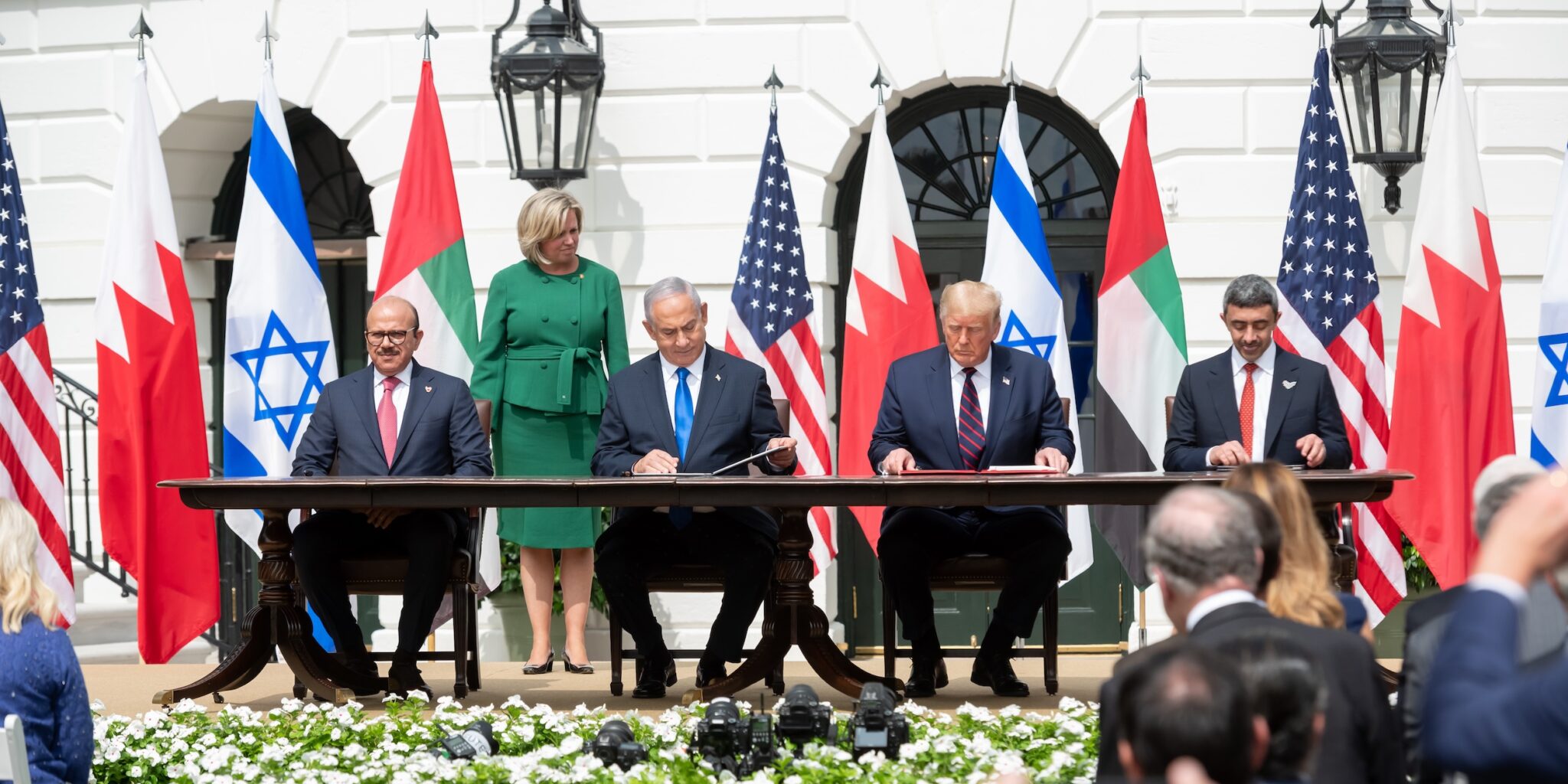
This market will resolve to "Yes" if any country not already a part of the Abraham Accords formally signs a normalization agreement with Israel under the framework of the Abraham Accords by December 31, 2026 11:59 PM ET. Otherwise, this market will resolve to "No". A formal signing refers to an official agreement between Israel and another country that is publicly acknowledged by both governments and clearly attributed to the Abraham Accords or their continuation. Countries already part of the Abraham Accords as of June 26, 2025—including the United Arab Emirates, Bahrain, Morocco, and Sudan—will not count. The resolution source will be official government statements, however a consensus for credible reporting may also be used.
Prediction markets show a broadly contested split on whether a new country will formally join the Abraham Accords before the end of 2026, with neither outcome commanding a dominant share of volume. The market resolves 'Yes' only if a country not already part of the Accords — beyond the UAE, Bahrain, Morocco, and Sudan — formally signs a normalisation agreement with Israel under the Abraham Accords framework by 31 December 2026. Resolution is based on official government statements or credible reporting consensus.
Market structure
This is a binary Yes/No market with a single resolution outcome. Volume is broadly distributed between the two sides, indicating genuine uncertainty rather than a consensus view. Resolution requires a formal, publicly acknowledged signing ceremony attributed to the Abraham Accords framework by both governments involved, on or before 31 December 2026. The four existing signatories — UAE, Bahrain, Morocco, and Sudan — are excluded. Official government statements serve as the primary resolution source, with credible reporting as a fallback.
Background
The Abraham Accords were brokered in 2020 under United States mediation, resulting in normalisation agreements between Israel and the UAE, Bahrain, Morocco, and Sudan — a significant diplomatic realignment in the Middle East. The framework represented the first such agreements between Israel and Arab states in over two decades. Since then, Saudi Arabia has been widely discussed as the most consequential potential next signatory, given its regional influence and its role as custodian of Islam's holiest sites. The October 2023 Hamas attack on Israel and the subsequent conflict in Gaza complicated and effectively paused those negotiations. The broader regional context — including shifting US foreign policy priorities and evolving Gulf state positions — continues to shape which countries are regarded as realistic near-term candidates for normalisation.
Key factors
Several structural variables influence whether a new signatory emerges before 2027. First, the status of the Israel-Gaza conflict: sustained ceasefire arrangements or a post-war governance framework could unblock diplomatic progress that has been suspended since late 2023. Second, US diplomatic engagement: American administrations have historically served as the primary architects of Accords-style agreements, and the level of White House investment in brokering new deals is a key dependency. Third, Saudi Arabia's posture: Riyadh has stated that a credible pathway to Palestinian statehood is a precondition for normalisation, making its decision calculus directly linked to Israeli government policy. Fourth, the positions of other regional states such as Oman, Indonesia, and others reported to have held exploratory contacts with Israel — each with distinct domestic political constraints. Finally, the definition of 'formal signing' under the resolution criteria means that back-channel progress or partial agreements would not qualify; only a publicly acknowledged, attributed ceremony counts.
FAQ
How is the 'new country joins the Abraham Accords before 2027' market resolved?
The market resolves 'Yes' if any country beyond the existing four signatories — UAE, Bahrain, Morocco, and Sudan — formally signs a normalisation agreement with Israel that is publicly acknowledged by both governments and explicitly attributed to the Abraham Accords framework. Unofficial contacts or unattributed agreements do not count.
When does the Abraham Accords expansion market resolve?
The market resolves on 31 December 2026 at 11:59 PM ET. Any qualifying formal signing must occur on or before that deadline. If no such agreement is completed and publicly acknowledged by that date, the market resolves 'No'.
What happens if a country begins negotiations but does not formally sign before the deadline?
Ongoing negotiations, letters of intent, or partial frameworks would not trigger a 'Yes' resolution. The criteria require a completed, publicly acknowledged formal signing ceremony attributed to the Abraham Accords by both governments before the 31 December 2026 deadline. Incomplete processes resolve 'No'.
What does the market currently show for Abraham Accords expansion?
The market is broadly split, reflecting genuine uncertainty about whether a new signatory will emerge before 2027. No outcome holds a commanding lead. Saudi Arabia is the most widely discussed candidate in public reporting, though no confirmed signing process is currently underway.
Paridesk is not a regulated financial advisor. The information above is for informational purposes only and does not constitute financial, investment, or trading advice. Prediction markets carry risk of total loss. Past patterns do not guarantee future outcomes.
Related Markets



Will a new country join the Abraham Accords before 2027?
27%