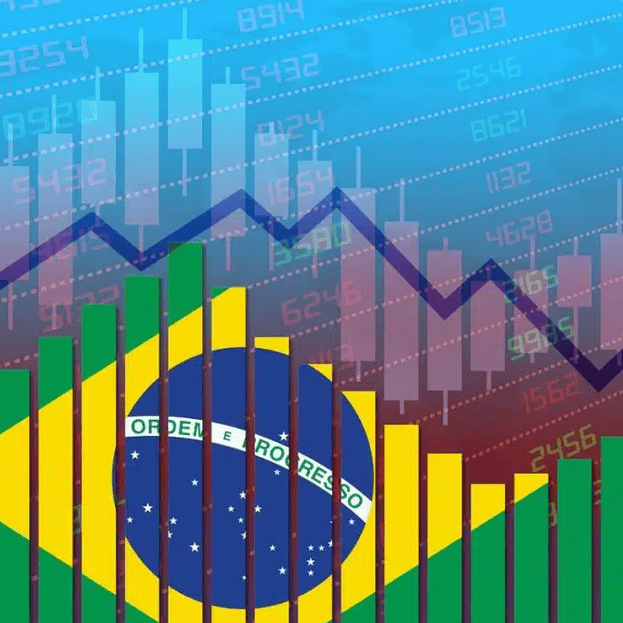
Brazil Annual Inflation 2026
5.00-5.49%
Order Book
5.00-5.49%
Resolution Criteria
This is a market about the variation of consumer prices in Brazil over the 12-month period ending December 2026, as reported by the Brazilian Institute of Geography and Statistics (IBGE). This market will resolve according to the percentage change in the Extended National Consumer Price Index (IPCA) during the 12-month period ending December 2026 according to the monthly IBGE report. The resolution source for this market will be the IBGE Extended National Consumer Price Index monthly report released for December 2026, currently scheduled to be released on January 12, 2027. Resolution of this market will take place upon release of the aforementioned data. If no data for the specified month is released by the date the next month's data is scheduled to be released, this market will resolve based on data from the last available month. You can find the relevant figure by locating the report for December 2026 on the Press Releases page (https://agenciadenoticias.ibge.gov.br/en/agencia-press-room.html), locating the Period-Rate table and finding the IPCA growth rate figure in the column labeled "Rate" and the Row labeled “Cumulative in the year / 12 Months”. Changes in the IBGE’s reporting format will not disqualify a published relevant figure from counting. Note: the resolution source for this market will be the official monthly IBGE IPCA news release which reports inflation during 12-month periods to two decimal points (e.g. 4.26%). Thus, this is the level of precision that will be used when resolving the market. For the full release schedule, see: https://www.ibge.gov.br/en/calendar.html
Prediction market trading on Brazil's annual IPCA inflation for 2026 is heavily concentrated in the 4.50–5.49% range, with the two bracketed outcomes in that band drawing the vast majority of volume. Resolution depends on the official 12-month IPCA figure reported by IBGE for December 2026, scheduled for release on 12 January 2027.
Market structure
The market spans ten outcome brackets running from below 3.00% to 7.00% and above. Volume is heavily concentrated on the two central brackets covering 4.50–5.49%, with the distribution tailing off sharply on both sides. Outcomes below 4.00% and above 6.00% attract relatively little interest. Resolution is determined by IBGE's official IPCA monthly release for December 2026, expected on 12 January 2027, with a fallback to the most recent available monthly data if the December release is delayed.
Background
Brazil's IPCA is the country's headline consumer price index, compiled monthly by the Instituto Brasileiro de Geografia e Estatística (IBGE) and used by the Banco Central do Brasil as the reference gauge for its inflation-targeting regime. The official target for 2026 is 3.0%, with a tolerance band of plus or minus 1.5 percentage points. After a period of elevated inflation in the early 2020s, Brazil entered a tightening cycle that brought IPCA down, but renewed currency pressure and fiscal uncertainty pushed inflation back above the target ceiling in 2024 and into 2025. The central bank responded with significant rate increases, raising the Selic rate to levels not seen in years. Market participants are watching whether that tightening proves sufficient to anchor expectations within the target band or whether structural and external pressures keep inflation elevated through 2026.
Key factors
Several structural forces will shape where the IPCA lands for full-year 2026. The trajectory of the Selic rate is central: the pace and timing of any easing cycle will influence credit conditions, domestic demand, and consequently price pressure across services and goods. The Brazilian real's exchange rate against the US dollar is a key transmission mechanism, affecting import costs and fuel prices, which feed directly into the index. Global commodity markets — particularly oil and agricultural goods, where Brazil is both a major producer and consumer — introduce further volatility. Domestic fiscal dynamics matter as well: government spending decisions and market confidence in Brazil's debt trajectory affect the currency and inflation expectations simultaneously. Administered prices, including electricity tariffs and fuel levies, can move independently of monetary policy and have historically produced step-changes in the IPCA. Finally, El Niño or La Niña weather patterns influence agricultural output and food price components, which carry substantial weight in the index. Any one of these channels could shift the final figure meaningfully across the current bracket distribution.
FAQ
How is the Brazil Annual Inflation 2026 market resolved?
The market resolves using the cumulative 12-month IPCA rate for 2026 as published in IBGE's official monthly press release for December 2026. The relevant figure is the 'Rate' entry under 'Cumulative in the year / 12 Months' in the Period-Rate table, reported to two decimal places.
When does the Brazil Annual Inflation 2026 market resolve?
Resolution is scheduled for 12 January 2027, when IBGE is due to publish the December 2026 IPCA report. If that release does not appear by the date of the following month's scheduled release, the market resolves using the most recent available monthly IPCA data.
What happens if IBGE changes its reporting format or delays the December 2026 release?
Changes to IBGE's reporting format do not disqualify a published figure from counting, provided the equivalent cumulative 12-month rate can be identified. If the December 2026 data is not released by the deadline, the market falls back to the most recent available monthly IPCA publication.
What does the Brazil Annual Inflation 2026 market currently show?
Trading volume is heavily concentrated on the 4.50–4.99% and 5.00–5.49% brackets, which together account for the dominant share of market interest. Outcomes below 4.00% and above 6.00% attract comparatively little volume, reflecting a broad consensus that inflation will settle above the official 3.0% target.
Paridesk is not a regulated financial advisor. The information above is for informational purposes only and does not constitute financial, investment, or trading advice. Prediction markets carry risk of total loss. Past patterns do not guarantee future outcomes.
Related Markets




5.00-5.49%
31%